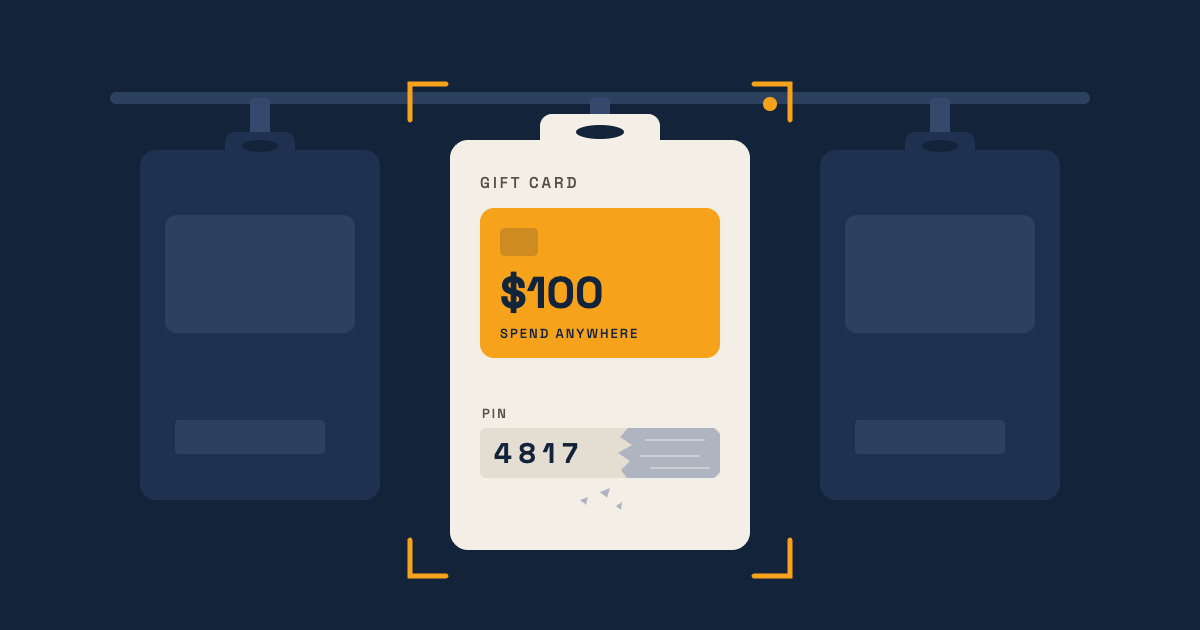
Why card draining keeps happening, and what the industry is actually defending against
Earlier this week, ABC News published an article on 19 reports of tampered gift cards. I'm confident that's just a drop in the ocean.
Two weeks before that, I was having a drink with my wife at a local bar. A woman was trying to pay with two open-loop gift cards, one EFTPOS and one Visa. The cashier was struggling, I stepped in, fairly pleased with myself, to help sort it out. Then we realised one of the cards had a PIN scratched off - unusable. Whether she followed it up with the issuer, I don't know. On values like that, plenty of people won't.
The effort of going a step further and reporting it to authorities outweighs the value, so it's safe to assume the real magnitude of this problem very rarely reaches anyone's data. It's good to see effort going into this. Authorities, retailers, brands and distributors are all combating it in their own ways. But better packaging is a temporary barrier. It's a puzzle, and the people and organisations committing this fraud solve puzzles for a living.
Two decades in this industry tells me the answer isn't a stronger seal on an old model.
What we're actually defending
The weakness isn't the packaging. It's the format. An open-loop card, meaning one that can be spent anywhere rather than at a single retailer, is a bearer instrument. Whoever holds the numbers holds the money. It sits on a rack in a public place with its secret under a layer of foil, waiting to be activated weeks after somebody has already photographed it.
Every defence we have built sits on top of that design. Better foil. Tighter packaging. Warning signs at the till. All of it is a better lock on a door that was never built to be a vault. The model that doesn't carry this problem is one where value is attached to a person rather than to a piece of plastic. Issued to a known recipient, claimed into an account they control, with nothing exposed before they claim it. If something does go wrong, the issuer knows whose it was.
The part that's harder to say
Tampering and breakage are the same problem in different clothes. In both, value disappears from a consumer and nobody upstream feels it. No cost line moves. No report flags it. Nobody is accountable for the number, so the number never improves. Victim-assisted fraud sits in the same place. All of it quietly erodes an industry that I, and many of us, genuinely care about. I spent two decades building in this industry, so I'm not pointing at anyone I wasn't standing next to. But a model where the consumer carries the loss and nobody else notices is not a model that fixes itself.
Originally published on LinkedIn, September 2026.